
Not only was Salt Lake City the first stop on the Limón Dance Company’s tour before heading to the Joyce Theater in New York City. This was the first time Mazurka was performed in its entirety since 1964.
Mazurka was choreographed by Jose Limón in 1958 and was inspired by his travels to Poland after World War II. The dance is built through multiple series of solos and duets, where Limón paid homage to each dancer and their particular strengths in the company at the time. I could certainly see the individuality of the solos and duets yet the work still represented Limón’s style of great gravity and breath. Overall, there was a sweeping joy knit throughout the work. The dancers carried a lightness within them, even while performing some extremely challenging movements. The control needed to find moments-long balances was astonishing and I applaud the dancers’ commitment in each and every line, extension, and high release. While Frédéric Chopin’s piano score risked sounding redundant, the choreography kept a clear through line and varied dynamics which kept my interest.
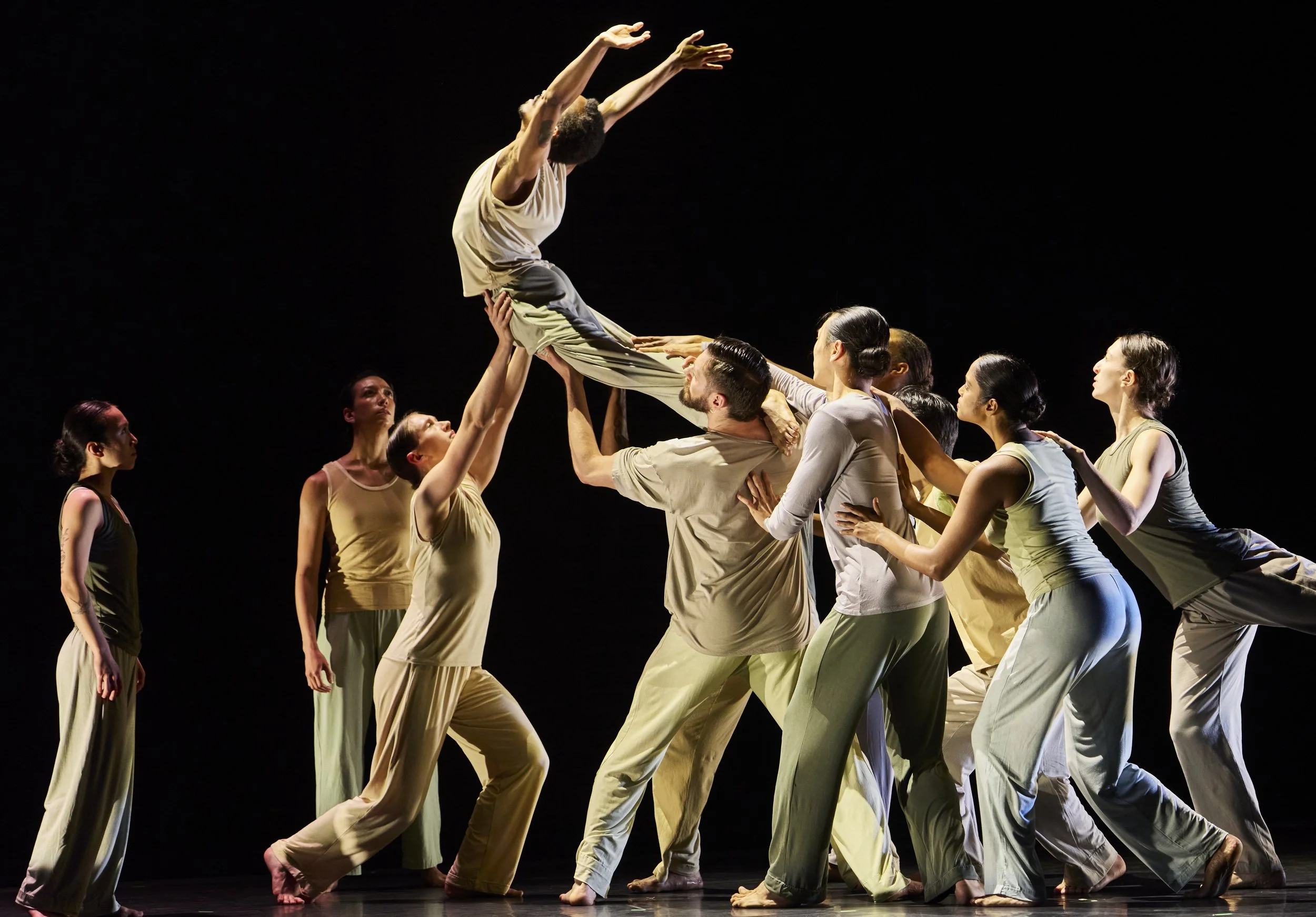
Photo by Kelly Puleio
The second work of the evening, Psalm, was performed by students in the School of Dance from the University of Utah and was restaged by Professor and former Limón company dancer, Natalie Desch. I was very impressed by these young dancers’ commitment to the movement and drive of the piece. This work did not stop. It was an attack. Psalm had Limón’s signature strike of movement combined with moments of release and control. I almost felt as if the work represented a warning or an omen and Limón recorded in his notes that the work was created to be “an evocation of the heroic power of the human spirit, triumphant over death itself.” Psalm was created in 1967 but I could easily see it being a new work made today, in 2026. Walking away from the performance, I am shown just how much Limón’s work stands the test of time.
My personal favorite work of the evening was Aszure Barton’s Join. The cast of eleven moved with one breath, interlinked and interwoven. Similar to Limón’s work, Barton incorporated multiple moments of high release and an uplifted gaze. The dance was inspired by a selection of Limón’s poetic description of Doris Humphrey’s lost work of Orestes. In the program notes, Barton points to “our power as a collective is in our ability to connect, and that coming-together is joy…” This was evident in watching Join. I was reminded of the importance of connection. We never move through the world solely on our own, and do so through a series of connections with others. You are supported along the way. The partnering elements within the work underpinned this understanding. In some moments, dancers stood on others’ shoulders and in others, there were embraces and intervals of tenderness. Join was patient. It grew slowly over the duration and the score by Ambrose Akinmusire was a beautiful soundtrack for the embraces I witnessed within the dance.
I feel honored to have been able to experience such a beautiful evening of dance by the Limón Dance Company. Thank you to UtahPresents for bringing them to Salt Lake City.
Kara Robertson is a Choreographer, Director, and Writer based in Salt Lake City. She holds an MFA in Modern Dance from the University of Utah. She founded and served as Artistic Director of Karar Dance Company, a 501(c)3 nonprofit professional contemporary dance company, for seven years. She is a 2024 Virginia Commission for the Arts Choreographic Fellow. Her work has been performed throughout the country including at the John F. Kennedy Center for the Performing Arts and at the Ailey Citigroup Theater and Gibney Dance. Kara holds a Bachelor of Fine Arts in Dance and Choreography from Virginia Commonwealth University. When not in the studio or attending performances, you will find Kara working in development, raising funds for programs at the Marriott Library at the University of Utah. Find her at kararchoreo.com and on Instagram @kararchoreo.