
Roxanne Gray and I sat down to reflect on her work last November with Utah Presents “To Be a God”, and her upcoming annual project PlayGround Dance, July 17-18th, 2026, at the Leona Wagner Black Box Theater. What emerged between us was a conversation about collaboration – in all its facets, the underpinnings of democracy, and how the field of dance is shifting lately.

Photo by Todd Collins
Halie Bahr: I’m really interested in what ideas continue to circulate within artists over time. So, to start, I want to know more about this most recent curatorial work, “To Be a God,” but also what ideas have been circulating with you for much longer?
Roxanne Gray: I've been conducting my own research over the last several years on collaboration: different modes, models, and collaborative structures.
How do we bring the right people together?
How do we set them up for success in this particular space?
And then how do we let the work be what it wants to be?
This has been an ongoing kind of research vein of mine for the last few years. “To Be a God” was born out of Utah Presents, which unlocked resources to create a whole laboratory for this research. I feel so honored to have worked with every single person involved; each was open-minded and allowed the work to take shape from everyone’s input — a true collaboration.
I've also been doing a lot of reading and looking at other collectives. How do you create this sort of democratic creative space in which every voice is heard, every discipline is valued at the same level? Then, what seems really counterintuitive, but there is a need for a director within that collaboration for it to succeed. It seems like two different things, “like wait, we're trying to get rid of the authority,” but in my work I find a great marriage between those two models.
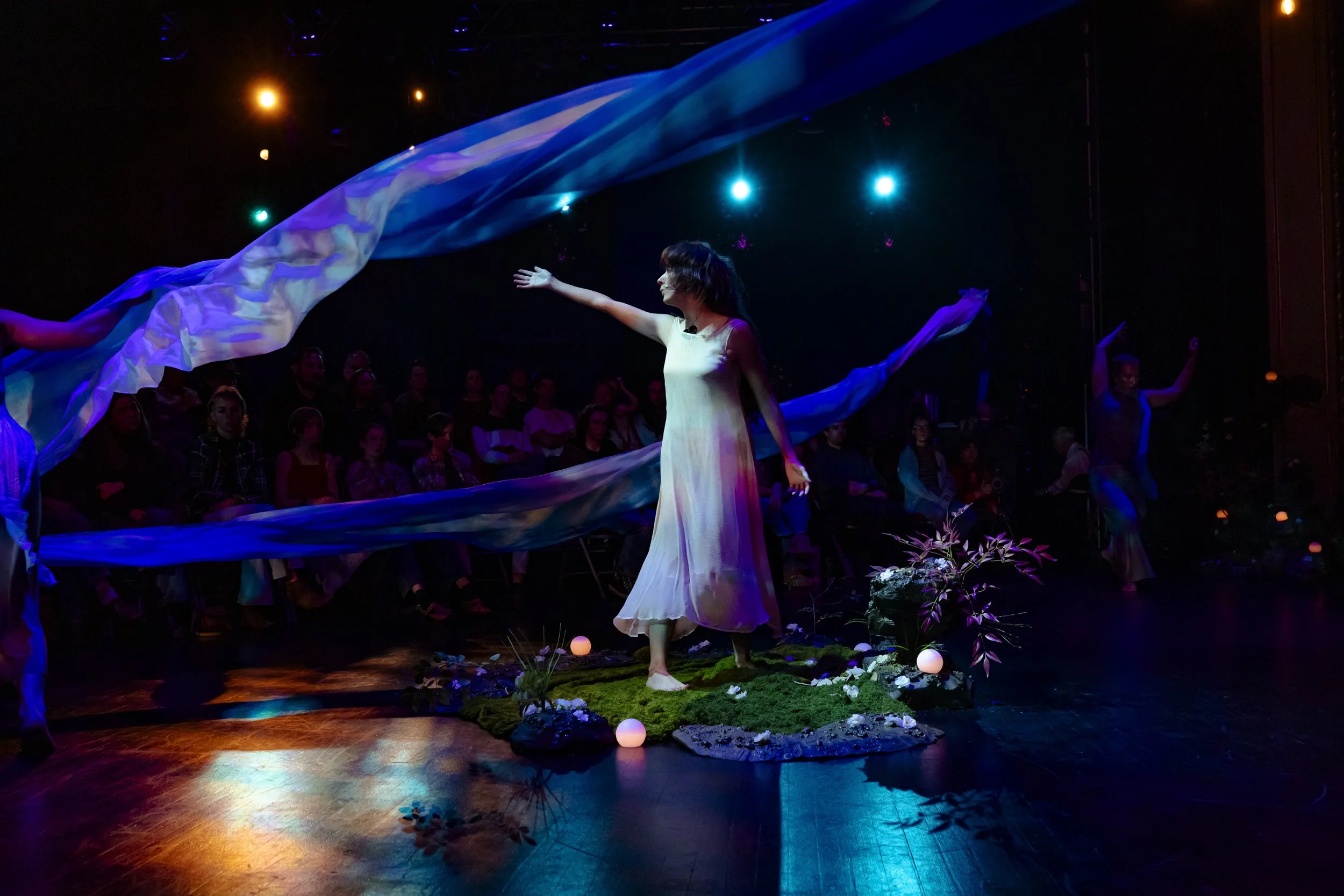
Photo by Mario Alcauter
Little Moon [Emma Hardyman] is an incredible, genius music maker, and she brought a 10-piece ensemble of collaborative musicians and producers to create the music. I also cast 16 University of Utah students from the School of Dance. And then, Ty Davis was the director, who is just an incredible visual artist, musician, and stylist. Samijo Kougioulis was the Stage Manager, and then I could just wear two hats as the producer and choreographer.
HB: You had this really lovely group of skilled professionals in the space that could all lean on each other. When that happens and everyone's on the same page, I can see how magic could happen. Sometimes, I feel so isolated as a choreographer in dance because there are such tight funds, and the nature of DIY work is that — I do everything myself. But to be able to work with other professionals in this way, leaning on each other to create something bigger than what each of you could do alone, sounds so dreamy.
I see that's so clearly a theme in your presentation work with 801 Salon too.
RG: There's a lot of ways you can collaborate with folks who have similar creative practices [like a dancer with a dancer], but I personally really love a collaboration in which everybody is bringing something different. Everyone's bringing the thing that I can't do! It's just so fun. It sets us up for success because there's no butting of heads, but really, there is this cool web of a shared language that comes out of different disciplines colliding.
In addition to the collaborative team with Utah Presents and Kingsbury Hall, it was also a collaboration with their administrative services; their marketing team worked collaboratively to market the show. When we were in residency, the lighting designer, James Padilla, was building and figuring out the work with us. The tech director is up in the rafters as we’re discovering the work together. I've partnered with a lot of organizations through 801 Salon over the years, and this was one of those moments where we each offered something so different but so monumentally, mutually beneficial.
“To Be a God” was part of Utah Presents Stage Door Series, which is something that Chloe Jones [Executive Director of Utah Presents] has really pushed the past few years. These performances feature local artists, and the only caveat is that the audience has to enter through the stage door and sit on the stage. Kingsbury Hall is this incredible historical theater. They bring amazing, international performances to our community. And yet, so many folks haven’t experienced the perspective of stepping foot onto the stage.
HB: I am thinking about how much I enjoy being on stage in a large theater, and also up-close-and-personal in a smaller black box space. I'm struck by the simplicity and brilliance of bringing the audience on stage in a way that subtly shifts the frame; it brings the audience closer.
How did that feel for you and the other collaborators?
RG: It very much informed and drove the work. Little Moon, they're very well known. They won the NPR Tiny Desk Concert a couple of years ago. Little Moon could have very easily just done a concert and filled that theater, and would have been an incredible act. But, because the Stage Door Series asks artists to try something new, this is the type of structure that creates fresh work. All of the Stage Door Series shows that I've been to [over the years] are all completely different, even though it's the same space and technical crew. Heartland Collective’s show last year was dancing out in the seats of the theater and through the audience. Plan B Theater had their show in the round. So, just the fact that this series exists is monumental.
HB: What are the ways that the Stage Door Series “rules” left an imprint on the work?
RG: A big part of the creative choice making was “let's not throw away this opportunity, if it is on the stage, let's make it happen, let’s have this inform as many decisions about the work as possible.” So we had the audience enter the stage as sort of reverence. As they came in, they were already in the performance.
The doors opened 30 minutes before, the lighting and staged pieces were set so that when audiences entered, they entered a world. Ty’s set pieces - he created this garden; it felt like you were entering this medieval garden!
There was this little ritual that when you [as the audience] came in the stage door, you would partake in this water ritual with sound bowls playing. So when you sat down, there was a hush, everyone was so present. And then, when Emma [Little Moon] came out to start the show, it was royalty entering.
Another challenge that left a lasting imprint on the work was the creative limitation of having all 100 of your audience members seated on the stage with 16 dancers, 11 musicians, all the sets, everything. But, those kinds of creative limitations are wellsprings for ideas. How do we make it interesting? We had some of the dancers move behind the audience, so there were a lot of the audience members who saw certain parts of the show spatially that other people did not see because of where they were seated. Then, it was really fun watching the audience when they would look and see that there was a whole section happening behind them that they didn't even realize.
HB: Lately, I really love work that shows the internal working of the craft. Not to demystify per se, but when the audience gets to peek inside the logic of the work. They get to see the technical crew’s inner workings, the cues, the costume changes, the perspective from the performers. All of the things you don’t typically see that happen “off stage” or in invisible spaces. It’s all open, and you see everything.
I’m also thinking about interdisciplinary collaboration a lot lately, and this is something that you have a deep history with Roxanne. Dance sometimes silos itself from the other disciplines in a way that I think makes it hard for audiences to feel really engaged with it, or want to come see it, or take that risk to go see it. But I think this particular collaboration [“To Be A God”] kind of highlights something I've been thinking about for a while, which is these different models for sharing that other disciplines do really well. How else can we rehearse, craft, collaborate, share our work – that may veer outside the traditional model of dance creative processes – but that is in service to the humanity of the people with ethical labor practices, and also make meaningful work.
While this is not a perfect model, the punk-band-touring-in-a-van model has worked for a long time because it's affordable. In my own creative work, I turned to solo work because of this ethical dilemma – I couldn’t afford to pay collaborators. SB Dance’s Curbside Theater [based in Salt Lake City, UT] moves a small scale stage around on a trailer to creatively grapple with venue costs, and this creative solution then also helps draw different audiences to their work. There are a lot of experiments happening that are circling around this question about more ethical ways to make dances, and I am really humbled and excited by it.
Dance as a medium really struggles with the cost of labor being much higher than some other artistic practices. I am thinking about interdisciplinary collaboration much more lately because I have this deep desire to learn from the way other practices make work possible. What are some ways of creating that I am not aware of that might make the financial piece of creating work more possible for dance artists? We can learn something from the way that musicians tour, or visual artists share their work. This very much feels like it aligns with your work at 801 Salon, and specifically what I know about PlayGround Dance Project.
RG: Yes! More and more I see creative processes that are short residencies because of this ethical question. When it comes to PlayGround, that is a big part of it. We are trying to model ethical freelance practices. So we pay everybody a stipend based on an hourly rate, and choreographers are not allowed to go over in rehearsal time because the dancers have been hired for their time. PlayGround is setting up some rules, modeling a framework, that could also be adopted in your own professional freelance practice.
But the only way PlayGround can afford this ethical framing is by putting it all in one week. This value of ethical pay then limits the time – it generates this incubation that’s really about creative limitation. We create work in only one week in service to sustainability of the field. What happens then is people take a lot of risks, they make incredible, bold choices as part of this incubation.
RG: I feel like if you [as a choreographer] have a project idea, and you don't have the funds, then I’m really interested in how you change the scope of your project, and what does that mean? A shorter process? What creative challenges emerge? A different venue or rehearsal space or theatrical elements? And for me, that's a way that dancers can make work more sustainable.
HB: And, at the heart of the question, maybe I’m realizing now that we're actually talking about how the field continues to shift under the pressures of this current world. Time is costly, so that naturally feels like a factor that can slide up and down based on cost.
I still love long creative processes, but it is a luxury. Time is something that dance deemed necessary for a long time, based on aesthetic choices that some choreographers were making in history. Time became really essential to making dances because it had to look a certain way, crafted a certain way, unison takes time, partnering takes time, repeatable phrases take time. The craft itself takes time!
RG: Yeah, it's a luxury though.
HB: And, just to continue the dilemma, I don’t always want to feel rushed when I am making either. Having time and space changes the kind of work that is made entirely. I wonder about the other ways that choreographers choose (or don’t choose) to grapple with this question too. It makes me think about how these shorter processes [like PlayGround Dance Project] are happening more, and in turn how it might shift the field in really interesting and exciting ways, meaning it will change the look and internal logic of the creative work itself!
RG: To circle back to Little Moon [“To Be A God” with Utah Presents]. I’m sitting here thinking “okay, what is it that musicians do?”
They [musicians] get on a bus or a van. Little Moon did a whole NPR tour. They performed at all these great music venues all over the country. Little Moon is not on a polished stage when they're on tour. They're in sticky bars, really cool places like Kilby Court [Salt Lake City, UT]. Dance can absolutely do that if they can give up their idea that it's supposed to be on a polished stage.
I've seen different versions of this, but it’s a “we’re bringing the stage to you”. In 2020, Lauren Simpson created “Moving Truck”, a performance for the front lawns of Omaha residents; it was featured in the Kennedy Center’s Arts Across America. They [Simpson] rented a little flatbed UHaul as their tour. They drove around, showed up, did a performance, and then packed up and left. And this was $20 an hour for the truck!
That's what 801 Salon does. We use gallery spaces to make it happen, and in turn there are really fresh ideas that come from it. I feel like maybe since the pandemic, I have just really had a deep interest in working with other people and sharing ideas and seeing what happens to those ideas when you allow them to kind of be in a petri dish together, they affect each other, the ideas grow together. I have learned a lot of lessons too, what works for other people, what kind of communication needs to happen.
The idea that interests me the most lately is from my thesis research on Chicana feminist methodologies – really valuing the lived experiences of your research, the people that you're studying (which were my dancers), and valuing their experience, their thoughts, and asking them to co-create with you. That's a deep part of Chicana feminist methodologies, and since graduating has become a part of my work and was funneled into this project with Utah Presents.
How to create this kind of flat democratic structure of collaboration, but still have a director that funnels the experience. Not even really an end-all-decision-maker, but without someone feeding it, it can die. And I like to think of this model as a sourdough starter: how do you keep feeding it? How do you keep it alive? And also, how do you stay flexible enough to pivot when the work wants to pivot?

Photo by Todd Collins
HB: How are all these creative elements within a co-creation actually more like play-doh forming together? I am also thinking about the ways I see collaboration struggle too! Experimenting and asking alive questions together, the work is continuously forming even as you’re getting into the production. And at some point, this deadline gets scary and big, and then things get finalized, and nothing can change or be playful anymore.
There's a capping on the creativity that’s possible. But I wonder when you have the right interplay of people and skills – the play can still occur. There is a magic that can happen. There is this ability to keep that question alive even through the production, which is rare, and also feels really timely to the world that we live in right now. Where dance work only lives in performance for what feels like a millisecond. And maybe, the work can live beyond that one production and evolve.
RG: I feel like in the past few years I've been giving myself a lot of permission to focus on my own identity as a woman. This has always felt a little selfish. I've discovered that by focusing on my own identity, it always immediately opens up the opportunity in my work to help other people focus on their identities. It’s not selfish.
Most of the work I've been making lately, it speaks to what you're just saying. I like responding to the folks in the room, the people that are there with me. That's just what I'm interested in, and no shame to any other kind of process or any other way of working. I like dancers having to make decisions together that I as the choreographer can’t hold alone. The experiences and backgrounds of the people that I am working with also become the intrinsic fabric of the work. That's collaboration. That's what develops care about what the work means together.
HB: Thank you, Roxanne, for this lively conversation. PlayGround Dance returns for its fourth season, July 17-18, 2026. You can purchase tickets online and learn more here.
Roxanne Gray is a Tejana Salt Lake City-based independent choreographer, performer, teaching artist, and curator. She is the Founder, Director, and Curator of 801 Salon, a multidisciplinary arts and performance series in Salt Lake City.
Halie Bahr is the associate director and editor of loveDANCEmore. She is a professor at Hamline University, and creates performances nationally. In 2024, Halie was awarded the Performing Arts Fellowship through the Utah Division of Arts & Museums. www.haliebahr.org
This work was edited by Halie Bahr, with the support of loveDANCEmore intern, Bobbi Torgerson.