
If you missed This Will Destroy You, directed by Molly Heller, then you’re probably not still sitting with the beautiful, visceral, overwhelming energy that flooded through the audiences last month at the Rose Wagner, presented by Repertory Dance Theater’s LINK series. The show took me through a tide of tightness, heaviness, activation, flashes of energy, anticipation, and discomfort, traces of which are still lingering in ways that I feel lucky to have received. I sat down with the cast last week to talk more about their side of the experience. I wasn’t totally sure how to approach this interview because this work was so physically evocative and didn’t call for much conceptual ideation for me. It sent me into deeper feeling states and I left a little wrung out, a little softer, and a little more in tune with my own darkness. Our conversation touched on these feeling states, the process of making the work, and how the performance is still resonating through each of us.
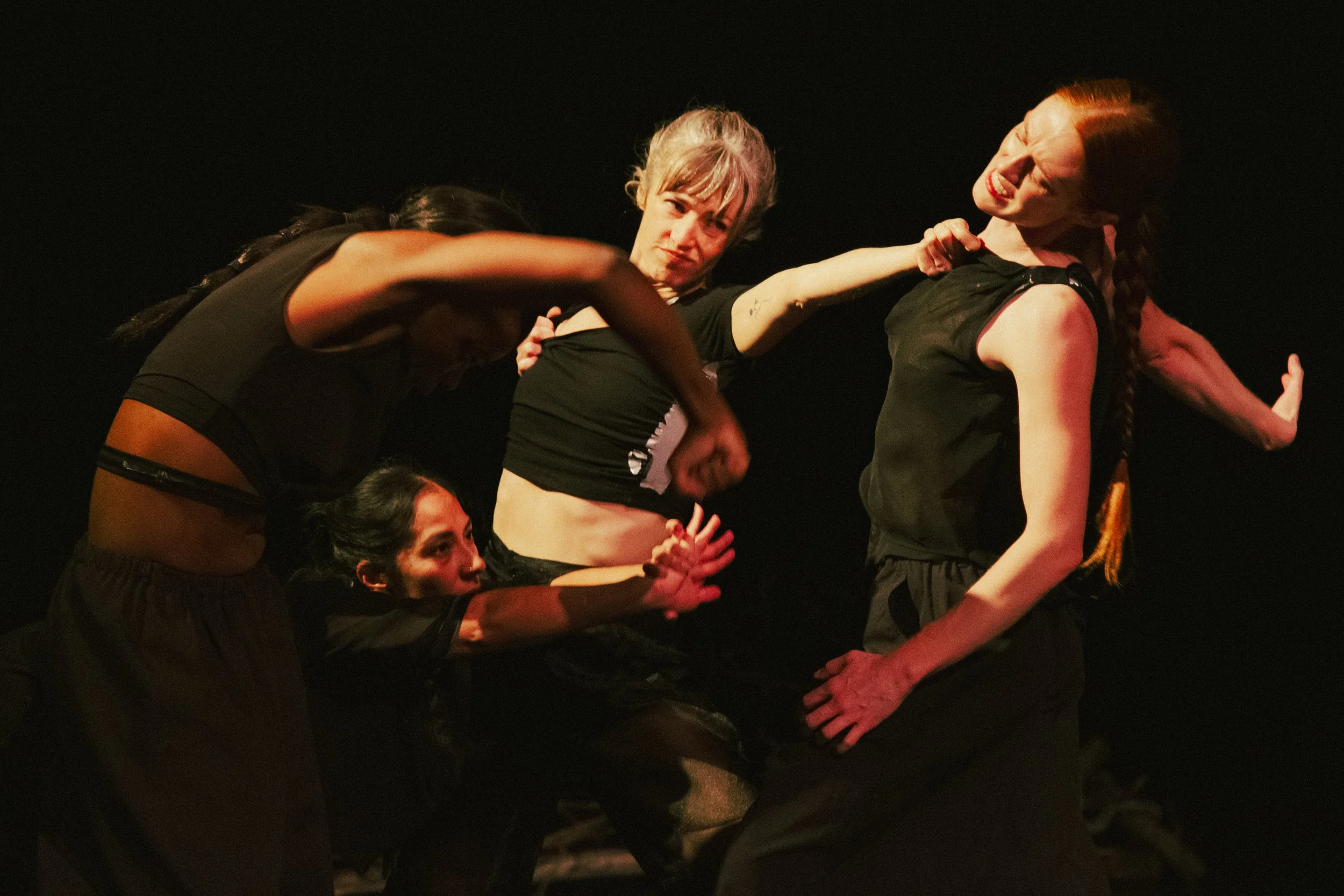
Photo by Ryan Ross
It started with a bang, Molly Heller herself striding down from the audience wearing symbolic armor, designed by Roxana Sevilla. She exploded through the space with strength and tension, fingers always alive, drawing me into what she was seeing around her but mostly seeming to grapple with this heavy, demanding energy from within her. The music, composed by Nick Foster, was driving us into a deep sense of gritty, thick energy from the moment we took our seats and continued to imply an underlying darkness that moved with its own intelligence throughout the show. Kellie St. Pierre’s highly textural films had a strong presence throughout the whole work. The tree-branches on the floor of the stage space bled into the winding layers of creatures, faces, and shadows that shifted behind Molly’s movement, connecting dancer, space, and projection. Molly’s solo ended sooner than I anticipated, and the piece began to sink into itself. Molly appeared as a ghost on the edges, only fully reappearing at the end of the piece when the group helped remove the armor she was wearing. Together, they revisited a series of movements from the start of the work but now with Molly in a space where previously the dancers had seemed magnetized towards an unknown entity.
Molly Heller: I was the catalyst for the storm—the storm of grief that gets spit into the space, and then there's the residue afterwards. And I toyed with my role during the whole process. We talked about it a lot as a group. I had a self-consciousness about being in the piece because originally I was intent on just directing. There was something that kept emerging about this destruction in my body and intensity of physicality that I couldn't run away from, and this looming presence that would sometimes pop in (against the wall with Tara and Ursula, or at the end with everyone to take the armor off), and then there was this invisible relationship between Stephanie and myself, and this gesture on the face that we both shared. I felt like my body was in the dance the whole time, like everything they were trying on, my body was also doing with them. The “outsiderness” that I put myself in did bring up a longing or a loneliness that I wasn't anticipating but in the end, the joy that came from working with this group of people countered that so much that it became something else empowering altogether.
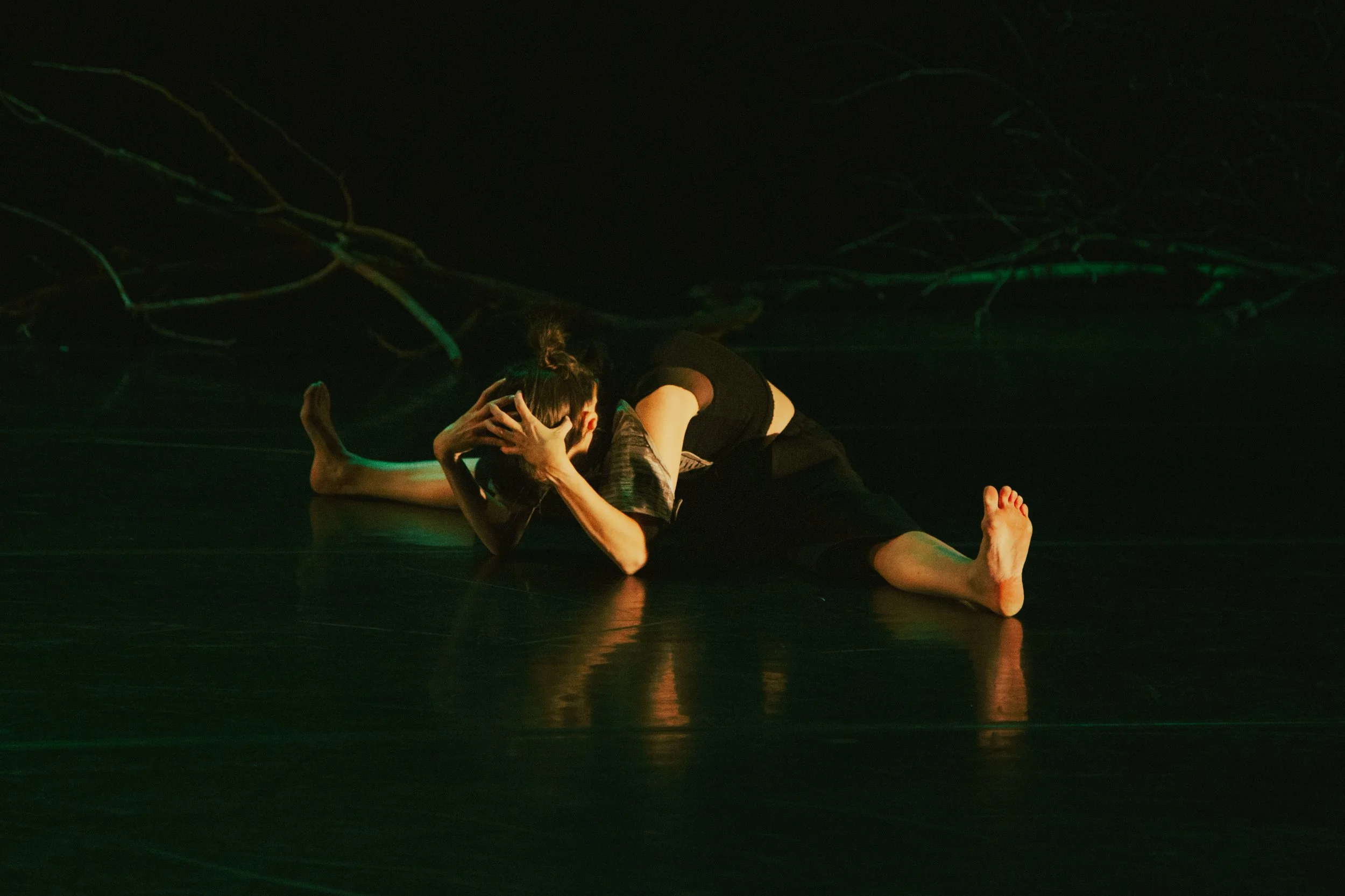
Photo by Ryan Ross
Most of the work focused on the performances of Ursula Perry, Stephanie García, Marissa Mooney, and Tara McArthur. They moved with a deep awareness of each other, but without an explicit narrative in their relationships. At times their touch would seem comforting and supportive to each other and then shift slowly into something sticky and suffocating, disrupted by long periods of vibratory shaking as if from a fever. I felt my body move through waves of tension and release as the dancers held each other through extremes of physicality, as if slowly untangling the dense story blasted out into the space by Molly’s solo. The intensity never lifted even as we moved through a growling, territorial duet by Stephanie and Tara, an emotive monologue-esque solo by Ursula ending with a defiant slam into the floor, Mars choking or crying or laughing after biting the ominous apple from the poster. It felt like I had eaten something poisonous with them and was slowly feeling my body break apart with them in more ways than I could imagine breaking as the work evolved. And yet they stayed committed to every moment, how could they sustain such emotional intensity over the length of the performance?
Ursula Perry: I really didn't save anything. There was so much joy in the process of telling these stories and the weight of these stories, it was a healing journey that we took. By giving it justice every time I did it, it’s giving the moment justice of when it happened to me. I think I wouldn't have been able to tell the story accurately if I held back at any moment of whatever story I was trying to tell. The emotional ride and the emotional arc of how Molly curated the show - its depth, its integral churn, required that. The ride is different every time, but I just have to honor wherever it is. I can't pull myself out and I think it does a dishonor to everyone else who's in it because they're giving that as well, and it takes all of us in order for the story to come to fruition.
Stephanie García: It takes some sort of journey somewhere. By the end you are exhausted, but it is not taking you down in a negative way. By the end it feels relieving, it imitates the real process of healing when you really go through it and understand some things. There's this weight that is lifted, even when it was hard and painful, but it makes you feel good. And I don't know if Molly had this in mind or if it was a discovery that happened through these months working together, but by the end it was not something that is dragging your energy, it actually charges you in a different way. But the collective support is the key. There are some moments or feelings that are not very fun, but they won't kill you. We'll survive it.
Ursula: It's like a rage room
Tara McArthur: Which you enter into a physicality to get somewhere, as opposed to putting a narrative on something to then produce. Instead, you're just entering into something where you may experience it. And then having enough time to explore it that then it doesn't have to be so activating each time. On the other hand, there are many aspects that different layers would be revealed to me individually that I might chew on. Through shaking or vibrating or just little moments that I wouldn't anticipate that might evoke emotion for me. There is some sort of way that whatever would come up for me here and there throughout - it had room. That energy had room to move and turn into something else. I would say, sometimes, but not always resolve.
Mars Mooney: I tease Molly about her being a method actor coach because I do actually feel like this is the dance version of method acting. It feels the most honest when I allow a full feeling or full personal narrative to be a part of the thing, but in terms of sustaining that, I think something that is really helpful that Molly introduces and reminds us of is that the thing, the quality, the thought, the question, etc. is 100%. That doesn't mean that it's always the same type of energy that's at 100%. So, if you're coming in that day and you're feeling melancholic or really exhausted, you don't actually have to pretend to not be that thing. You can just 100% be that thing, but that there is a requirement to have an honesty within whatever that thing is. Molly gave us and encouraged this permission to lean into whatever that thing is. I think that lends itself to a natural stabilizing and helped sustain that experience.
Molly: I think that this type of work is a different way of reimagining choreography. The details and ways that movement emerges, or the ways that vignettes happen, or the ways that configurations exist, are highly structured and directed. But the approach to get there might not be teaching a “step” at first, but the created atmospheres/devised scenes/improvisational practices become more and more structured in a way that gives way to choreography. As a director, and from years of working this way and learning how to create trustworthy spaces, I feel I have a responsibility to provide containers for heightened emotionality and expression to safely exist within. Otherwise, from my experience, it can feel untethered, and you don't know where to land on the other side, or how to reconnect with each other. There is a responsibility to understand how to navigate making a work like this that is relentless in nature with people that I love very much—I want their hearts and souls and spirits to be okay on the other side, and to also understand that relationship then with the audience.
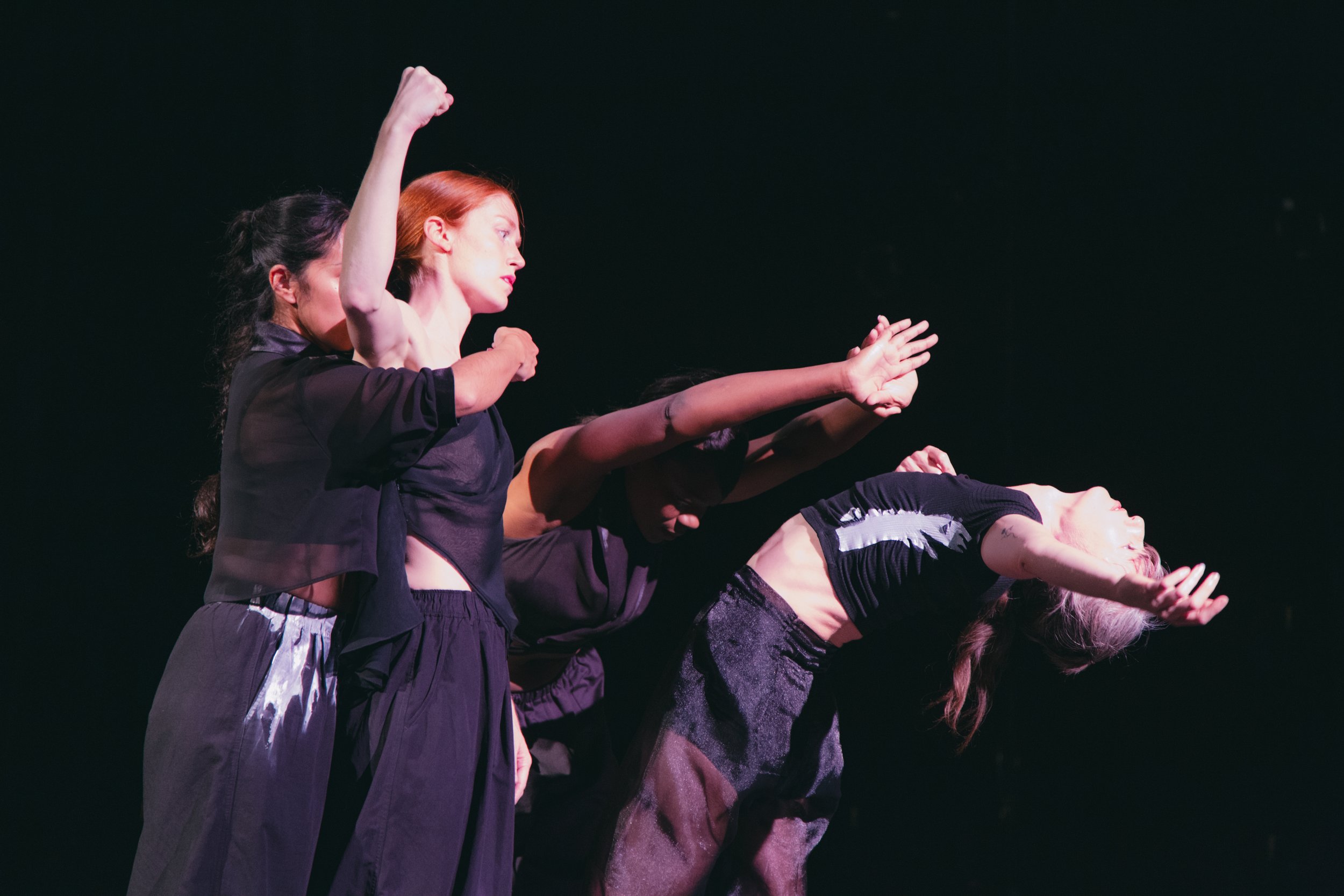
Photo by Ryan Ross
I could see the full voice of each cast member in the work, given light and time and space each in their own way. At the same time, they melded into a truly complete group, matching each other’s energy, providing the perfect knowing look that was needed at the right time, acting in ways so in tune with the intricacies of the moment. It struck me that while I had learned from, watched, or danced with all of these artists at one time or another, I had never seen them share a stage together. There was something uniquely stunning and heartbreaking to be with each of them together in such a vulnerable performance. How did they build the trust that was such an obviously deep connection between the cast members?
Molly: This group of folks had, to my knowledge, never danced together, and I didn't have experience working with most of them. Working in a process like this, I was very curious about them first as people in the dance community and as friends. Given the work’s content around grief and this theme that I was interested in of “what is destruction? what does it mean to be destroyed by something?”, I felt a guttural instinct about the four of them and their maturity. Knowing what I know about them and their stories, it felt like a group that would be very kind to each other, and wise and mature through a process that I knew required depth. We all came together about a year ago to start working.
Mars: It seemed pretty quick into the process of being in this space together, you just dive into the real stuff. It calls for that sort of closeness and intimacy and trust building.
Ursula: It was exciting to touch on one, a topic that I am unfortunately very familiar with, but also was interested in diving into. I could actually explore it for what it is with individuals that I knew that would integrally go on that adventure with me.
Tara: We had this whole year to actually let things settle not only as a group but individually as well in the way that grief evolves over time, in the same way that there's a kind of decay, we're also aging over a year and absorbing and having a different relationship to whatever we carry individually. That's just a huge luxury and commitment that I have not had many times at all over the course of almost a 20-year career to have that length of time.
Stephanie: The willingness of each of the people in the room to share and be open to a very vulnerable work, and that in so many ways we were connected in our lives, even without having shared it openly with the others.
Mars: It really was a huge gift to witness everybody in that space. I didn't stop feeling inspired by folks throughout this process because I do feel that everybody showed up with an honest vulnerability that wasn't performed. Witnessing that was changing. I'm not sure exactly how to articulate that, but there's something about witnessing people that you love being vulnerable that cracks me open and gives me permission to feel my own stuff too.
Tara: There’s just something about witnessing, being witnessed. The actual vibration of our bodies, right? That corresponds with the vibration of the earth. That in and of itself is I think what we're looking for in art and community, is having some sort of resonance with other beings.
Ursula: I entered this process with strangers who have held me more than I've ever been held in a process before, and so that was a gift in and of itself in this massive transition in my life. This gave me a newfound curiosity, not just about the craft and creation, but the curiosity in how we can go through this ride of a process, and how we can stay curious within it, and not just ourselves, but with the people around us. Seeing how people do things is really important, and watching them and discovering their evolution even if it's wonderfully ugly. A lot of times we don't really witness, we see but we don't witness. Allowing myself to really witness the grossness of me.
Molly: This piece was made with this group of people, for this group of people, and couldn't have ever been done in any other way without them. That's the beauty and specialness of it.
This wasn’t a show that I walked away from feeling energized to go out for a drink, or excited to create something, or even joyful about the world like when I leave most dance shows. I left feeling all of the heavy parts of my soul brought into high relief. I left thinking about the people in my life that I wanted to call and check in on. I left feeling like my heart had just been ripped open by those on stage. Especially as we were left sitting in silence and the house lights came up on an empty stage. Where were they? What were they doing in those last moments of silence? How did they decide not to follow the traditional expectations of a bow following the show?
Mars: It would have felt performative and not honest to then stand up and smile for people and do a bow. I feel like our full humanity could be there in the space. Not doing a bow felt like it honored that.
Tara: I'm still chewing on that too because I also feel that it wouldn't have been fair to ask of the audience to make that transition, to offer something back in a moment when, I felt it necessary that they be able to be with whatever was coming up for them.
Molly: You didn't know we were behind the curtains, waiting on the sides to listen for the silence because, wow, the power and loudness of the silence. And then I heard this one audience member say we were bowing for them the whole time, especially in the passes with their arms open, which was a tribute to—here I am.
Witnessing a work where the performers so fully laid themselves bare on stage left me aware of my own vulnerability and how I can honor the messy, painful processes within myself more fully. I am reminded of the value of putting something onstage that is alive, rather than something that’s been rehearsed into mind-numbing sameness, but something that opens an experience that gets relived, reimagined, and recreated each time in its fullness. I’m grateful to the artists in this work who are committed to their craft as a process of healing, caring for, and transforming themselves and those around them.
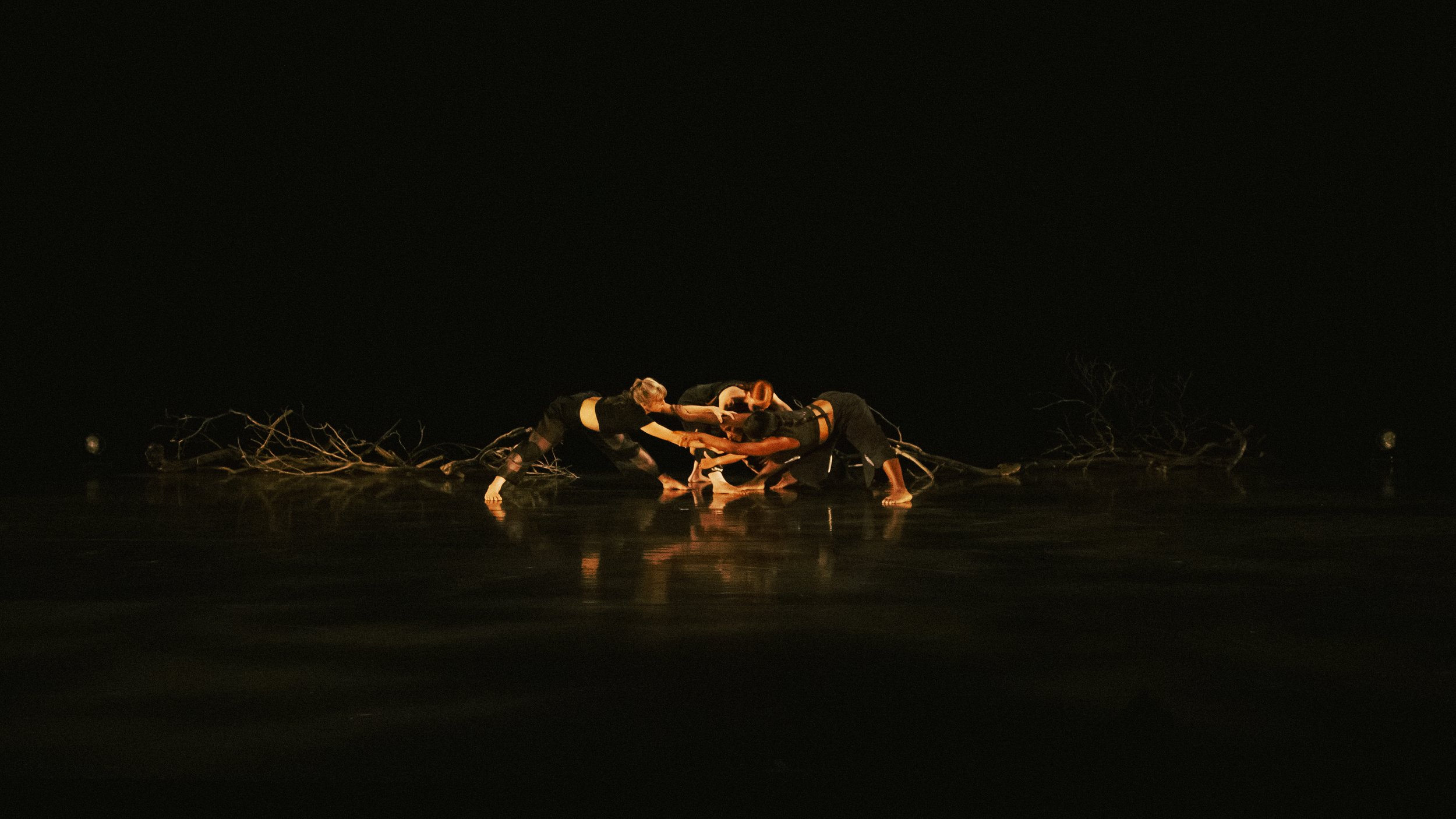
Photo by Ryan Ross
Kara Komarnitsky is an interdisciplinary artist currently making work in Salt Lake City. Her artistic practice approaches the complexity of human interconnection with the planet, seeking to make visible the invisible forces underlie our lives and connect us to each other – envisioning and transforming our collective idea of where our bodies end and where they begin. Her work has been presented at Illuminate Salt Lake Festival, Utah Dance Film Festival, Queer Spectra Arts Festival, 801 Salon, Red Rock Dance Festival, Playground Dance Project, Material Gallery, and Repertory Dance Theatre’s LINK series.
Molly Heller is the director of Heartland, a multidisciplinary collective based in Salt Lake City. She is also co-owner and co-director of Material gallery with Jorge Rojas and an Associate Professor in the School of Dance at the University of Utah. Her work has been presented nationally and internationally and her research explores performance as a healing practice and the relationship between physical expression and emotion. Molly holds certifications in Pilates and Reiki. As a performer, she has worked with Naganuma Dance, Netta Yerushalmy, Stephen Koester, Satu Hummasti, and Katie Faulkner, and has worked with Joanna Kotze since 2018.