
I met with Molly Heller and Jorge Rojas after the opening of their co-curated gallery Grief Work. We talked about the emotional experience of the opening reception, the vulnerability of the curation process, and the joys of being in community when surrounded by grief. Visual works are up at Material Gallery March 6th - April 10th. There are two more events as part of this exhibition:
An Evening of Performance & Film @V. PROJECT STUDIO
April 3rd, 2026, 6pm & 7:30pm: featuring time-based works including music, dance, performance art, and film
April 10th, 6:30–9:30pm: featuring performance at 8PM, followed by a Grief Rave
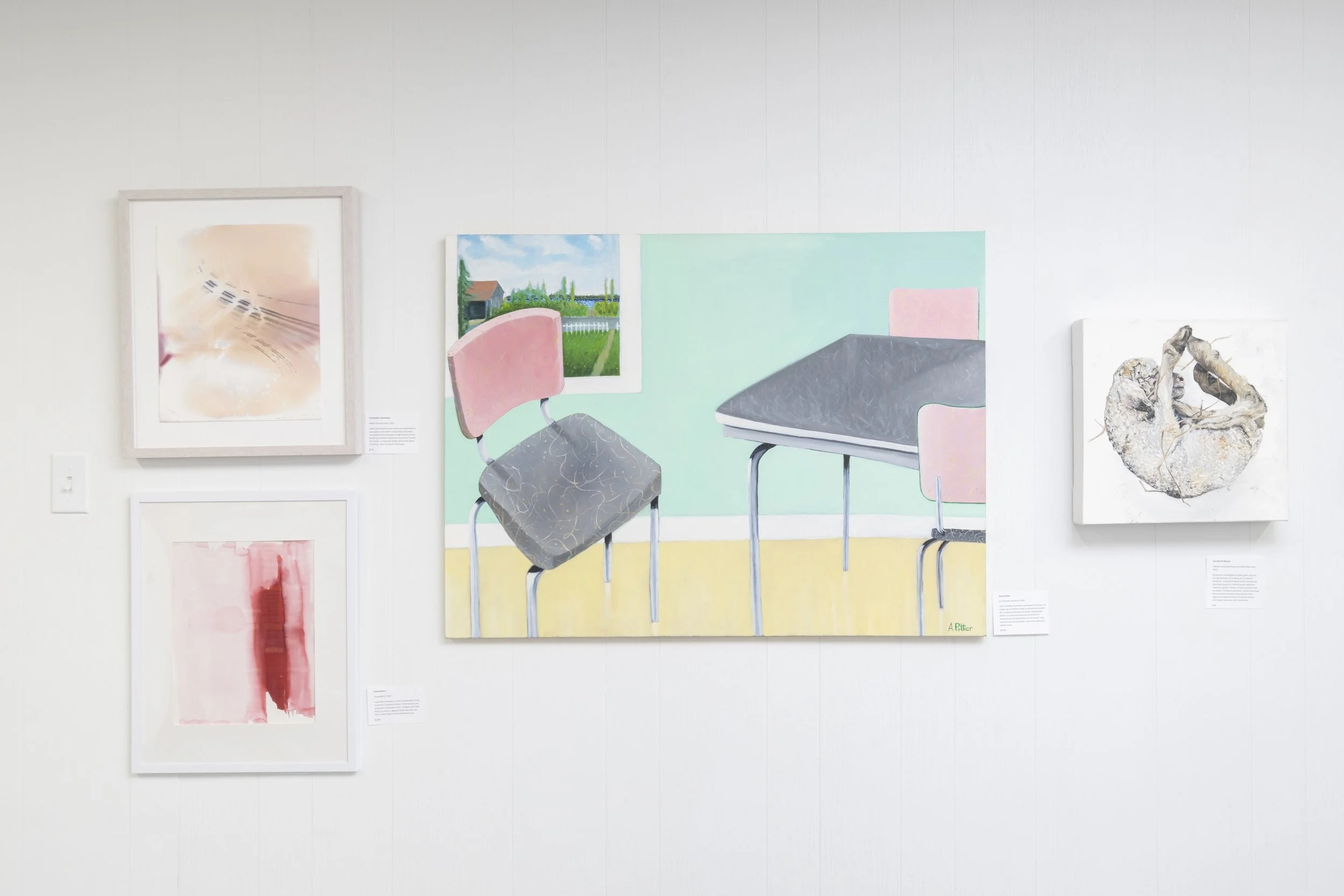
Photo by Adelaide Ryder; Artists Right to Left: Christopher Woodward (top), Irene Nelson (bottom), Anna Pottier, Zoe Nicole Nielsen
Kara Komarnitsky
What led this collaboration to circle around grief and what is your history, either as artists or personally, that has informed how you approached this project around grief?
Molly Heller
Grief is something that I've been working with over the last few years in a lot of my dance works, and trauma-informed practices are part of my research at the [University of Utah] so this topic isn’t new to me. That's been a baseline for a lot of the work I'm interested in, but grief specifically has come up over the last few years. And I was like, is there another side to grief? Grief on a personal level has been a part of my life for some time through major loss and a really traumatic accident last year.
And also, we are all sitting with it, on every level. It's not unique to me. But, I was feeling very isolated personally, and I was at that point where I wanted to be in community again. And so, the start of Grief Work was really just reaching out to find connection for myself.
As [Jorge Rojas and I] kept speaking, we agreed that grief is a collective experience. Even though we all experience grief very differently, universally, it's a part of life. I think grief can be really isolated, and we can have a lot of shame around it.
It felt like a gallery space could be a place to witness and share and not isolate – and also not have to fix it. Because, I think a lot of art practices, especially when you're writing, want a resolution to something, a box to be checked. That's just not going to happen, and that isn’t important, or the point, actually.
A byproduct of sharing it together, potentially, could be a release, or a way of feeling something else on the other side. Or we just are learning that we all go through it in one way or another, and learn that we're not alone.
Jorge Rojas
When Molly brought the idea to us, Colour and I felt it was a great opportunity to collaborate and build an exhibition around what felt like a necessary theme to explore collectively in community [Colour Maisch, co-founder of Material Gallery with Jorge].
Where grief really came into my work was during Covid, I was commissioned by Ogden Contemporary Arts to make a work, and I made a piece called Dance for our Departed. There was so much death and sickness all over the world, and we live in a country where our president was in complete denial about it, I was thinking a lot about how communities of color were being affected more directly by it and I was thinking, like, we don't have a place to mourn, and many people couldn't even touch their loved ones before they passed away or as they were passing.
And so I created this performance called Dance for our Departed, where I used some of my history using live streaming technologies for performance art, and I brought together 34 multicultural dancers all dancing together to the beat of the same drum and music on a Zoom call in different places, some as far as Mexico and even Hawaii and the whole idea was like, we can still come together and mourn. And it feels really, really necessary.
Kara Komarnitsky
I'm hearing familiar themes of this necessity of togetherness – how we seek that togetherness against structures or conditions that might make all this feel really impossible. How does this gallery either shift, conflict with, or challenge our cultural stories about what we do with grief? Where is it allowed to be? Who's allowed to grieve?
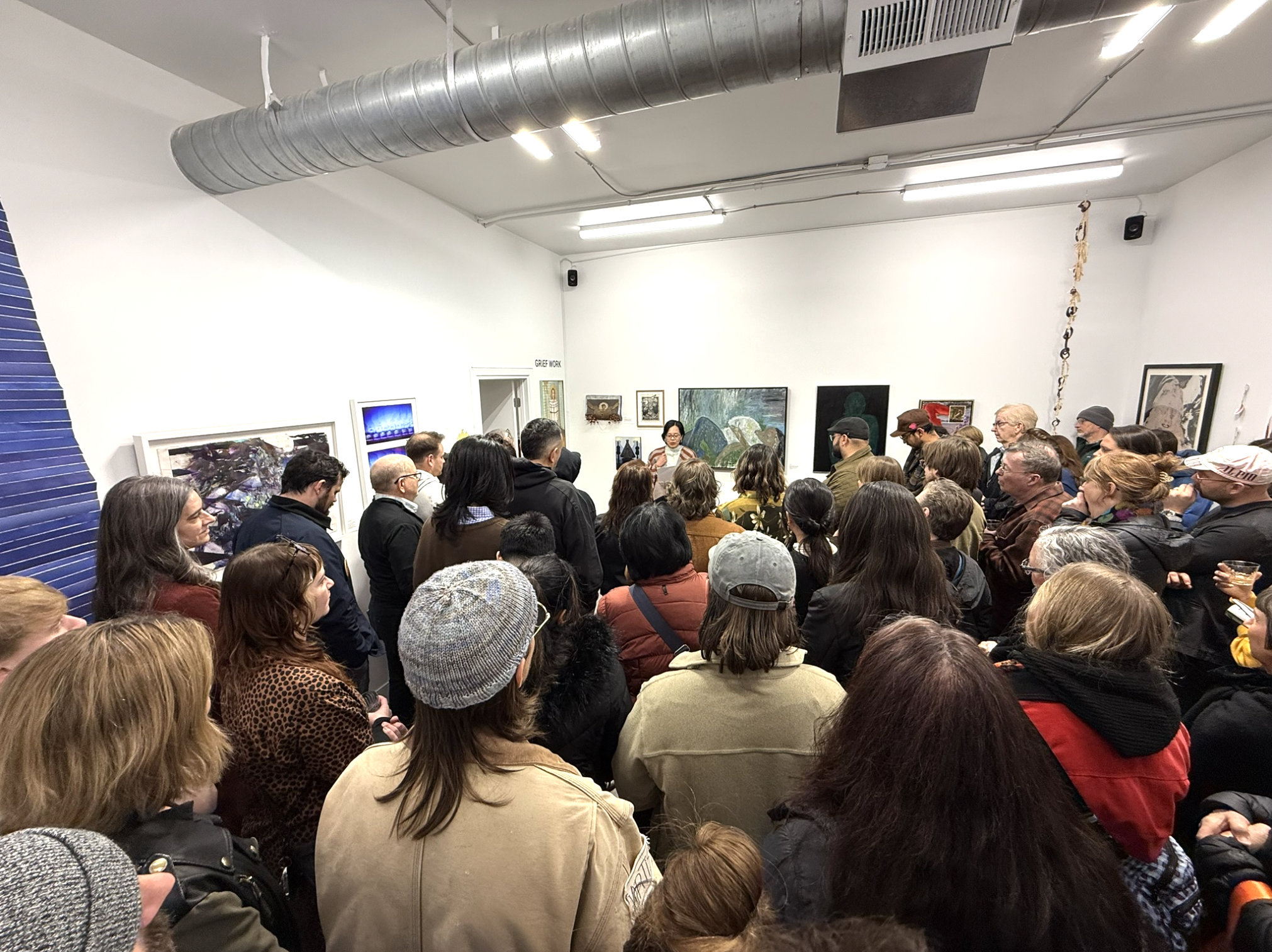
Photo courtesy of Material
Molly Heller
Well, I think what came up [at the opening] for me is, through spoken word, through an intimate space, through sharing something really vulnerable very up close, the way we all held tears, the way we all held emotion -- I didn't hold them very well -- it would have been a little different for me than if the theme wouldn't have been grief, it might have felt more uncomfortable.
I think you can have care for but not feel you have to be someone coming in to save the situation or fix it, and sometimes just being alongside someone and being a witness to it is enough. And so I felt a lot of softness, spaciousness, just listening.
*at this moment Molly is making a gesture with her hands, a soft pressing downwards that ripples through the palms and fingertips, gentle and calming*
Tears are on the ready right now for so many people, individually, collectively, politically, and ecologically. Just to have permission for a moment to let it go felt very palpable. And we don't have to do that labor. It's just holding space for it. It's just the trust in the space and the permission for it, and that felt really different to me than maybe other exhibitions.
Jorge Rojas
I think it's important to acknowledge that this country is really bad at grieving. I'm from Mexico, where we have a tradition of dealing with grief. We have celebrations around our dead, we grieve together, we march together, we cry together. Here, I just feel like there aren't good systems in place for grieving, community systems, cultural rituals, ceremonies, spaces dedicated to mourning, to grieving.
Molly said something to the extent of, this gallery shifts its role from just a place of exhibiting and sharing work to a place of specifically thinking about a certain topic together and processing together and inviting the artists to bring in their own perspectives.
What is very important to Colour, Molly, and I is that artists of color are represented, queer voices, trans artists, people with disabilities. I mean, there's so many different ways to grieve in the world, and so we tried to have as many voices represented. This is the most diverse thing we've ever done at Material.
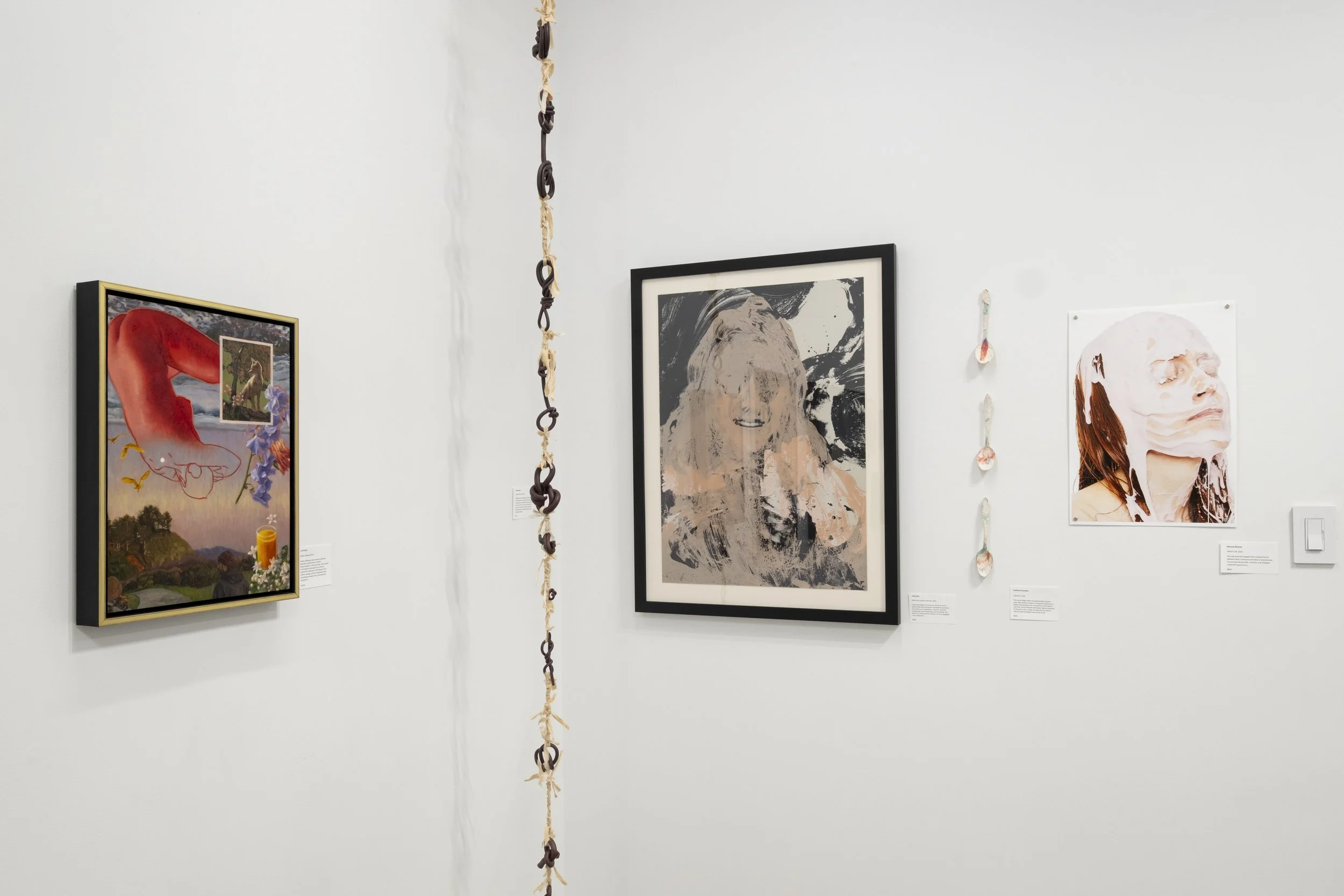
Photo by Adelaide Ryder; Artists Right to Left: Lis Pardoe, Vanessa Romo, Holly Rios, Kathleen Granados, Marissa Mooney
Kara Komarnitsky
There’s this key component that you've cultivated at every level which feels like that permission to be softer and slower and more patient. That was co-cultivated by everybody who came into the room [at the opening], the artists represented in the space, and how you presented the evening to the people that were coming so they knew what to expect, and that drew them into that energy.
Jorge Rojas
I don't think we're giving permission. I think we're inviting. Yes. Maybe that's the same.
Molly Heller
I loved how a couple of people afterwards were talking about what pieces really moved them and I heard a lot of people speak to how, this one element they didn't expect, just kind of broke them and cracked them open. And then the spoken word was the release into the space, and you're able then to process your feelings, instead of holding it in for afterwards, you can do it in real time.
Jorge Rojas
What was most moving for me, was seeing the artists in front of their work literally glowing with joy. And when you have artists that have had shows in the space and then an artist that it was their first time having their work exhibited, that was really sweet, too. There was a lot of joy.
Kara Komarnitsky
A phrase that's been very present in my grief journey is “this too” that within all the grief, we get the moments of joy and pride and togetherness, these things get to come along too... and I felt that [at the opening].
Jorge Rojas
Yeah. Someone said the most simple quote, this idea that our capacity to feel grief is proportionate to our capacity to feel love. The more we love, the more we live, the more we put heart and energy into what we do, the more we will breathe out when it's gone. The more human we are, the more we grieve.
Molly Heller
It's there, whether you want it to be or not. It just sometimes gets masked by other things for a minute, but it's going to show up. My grandma described it as this beast -- her family is from Lithuania -- and this beast that's over your shoulder all the time, it's looming, and I feel like it's always there. It doesn't go away, right?
*Molly is making a clawing gesture with both hands and leaning forward menacingly over the table*
Sometimes you're scared of it, and sometimes it's powerful, and sometimes it's sad.
Kara Komarnitsky
How did you prepare yourself to receive all of the submissions and how has your relationship to grief changed from the process of curating this show?
Molly Heller
I was a bit overwhelmed. I needed some time with it and I needed to visit the submissions in chunks so I could really show care on the other end and take care of myself at the same time energetically. [Jorge and I] might have said this to each other, but it's funny coming in with so much sorrow and what I'm experiencing the most is a lot of joy right now. I'm tired, but I feel mostly joy and a bit of hope. It's loosened the reins, and I'm not focused on my own stuff, by focusing on community, it’s much less.
Jorge Rojas
I think Molly put it in a really good way. Sometimes knowing that everyone else is grieving, allows you to feel a little lighter about your own grief. What we've created, it's like a collection of poems that we could publish into a book about helping us learn how to grieve by taking all the different forms of grief about the different things to grieve about.
And there was a lot of vulnerability in the process like that. We had to open up our hearts in a vulnerable way to really feel everything that was coming through. As humans, that's what we do, or we can learn to do. But as performers, we really understand what that means. It's about shutting “ego” off and turning “heart” on and allowing oneself to just be enough in that energetic place in order to read the work carefully.
Molly Heller
For me, it's like a sentence that keeps going, it feels like a culmination in some ways, and also like a beginning. At different times it feels like it has different access points for me in terms of the concept of grief and the feelings around it.
I'm making a work in the fall that's also a tangent of this, but it's becoming more about what destroys you, and what is the other side of that feeling? What do we do with it? What do we do with it collectively? How do we hold space for it? How do we have action?
Jorge Rojas
We've all been thinking about community. How do collectives bring energy together and make work that doesn't belong to anybody?
Molly Heller
And be open to community even when it's hard. I think there's a utopian idea about coming together needing to feel good. But you can also come together when things are hard, it's not always about joy.
I am so grateful to Molly and Jorge for sharing their perspective with me and bringing such care and intention to such a vulnerable topic. I’m honored to be included in this gallery, performing a work titled “Mine” on April 3 as part of the time-based works. Visual works are up at Material Gallery March 6th - April 10th. There are two more events as part of this exhibition:
An Evening of Performance & Film @V. PROJECT STUDIO
April 3rd, 2026, 6pm & 7:30pm: featuring time-based works including music, dance, performance art, and film
April 10th, 6:30–9:30pm: featuring performance at 8PM, followed by a Grief Rave.
Molly Heller is an Associate Professor of Dance at the University of Utah, where she received the 2024 Faculty Excellence Award in Research and serves as faculty in the Arts and Health Innovation Lab. She is the director of Heartland, a multidisciplinary art collective based in Salt Lake City. Her choreography has been presented throughout the United States as well as in Italy and Germany. Since 2018, she has performed with New York–based choreographer Joanna Kotze. For more info: mollyheller.com
Jorge Rojas is a multidisciplinary artist, performer, curator, educator, and co-founder of Material Art Gallery. Rojas studied art at the University of Utah and at Bellas Artes in San Miguel de Allende, Mexico. His practice spans visual art, performance, and social engagement, examining cultural identity, mediated communication, and systems of art production. His work has been exhibited nationally and internationally and is included in multiple public collections.
Kara Komarnitsky is an interdisciplinary artist currently making work in Salt Lake City. She received a BFA in Dance from Ohio State University and since then has performed with Myriad Dance Company, Fem Dance Company, and Repertory Dance Theatre amongst many community shows; presented work with Illuminate Salt Lake Festival, Utah Dance Film Festival, Queer Spectra Arts Festival, 801 Salon, Red Rock Dance Festival, and RDT’s LINK series; and continues to seek out new avenues of cultivating wonder in her communities.
Halie Bahr is the Editor of loveDANCEmore. For inquiries please message halie@lovedancemore.org
Grief Work is A group exhibition curated by Molly Heller and Material, open March 6 – April 10, 2026. The exhibition features works by Jenny Abramson, Andrew Alba, Kirsten Beitler, Sumedha Bhattacharyya, Jenny Chernansky, Steven Chodoriwsky, Esperanza Cortes, Pablo Cruz-Ayala, Rafi Ruffino Darrow, Stefanie Dykes, David Enriquez, Lares Feliciano, Susan Flores, Kathleen Granados, Andy Hayes, Bryan Hutchison, Zak Jensen, Barry Jones, Kara Komarntisky, Ava Kostia, Beth Krensky, Aya Krisht, Kelly Lawler, Kristina Lenzi, Stephanie Liapis, Caroline Liu, LeGrande Lolo, Elías Magdalena, Trinh Mai, Daniel Maldonado, Vincent Mattina, Kym McDaniel, Cameron McLeod, Christina McPhee, Marissa Mooney, Nuha Moretz, Christy Nelson, Irene Nelson, Zoe Nicole Nielsen, Lis Pardoe, Anna Pottier, Chaz Prymek, Holly Rios, Vanessa Romo, Wren Ross, Alejandra Saunders, Victoria Schiodtz, Andrew Rease Shaw, John Sproul, Hannah Vaughn, Peter Wiarda, Tyler Wilson, and Christopher Woodward.